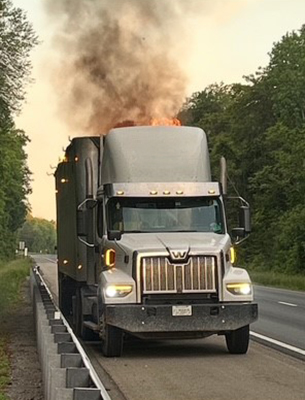
Protect your family and dispose of lithium batteries properly
FREE Lithium Battery Disposal Program
Lithium battery fires are on the rise nationwide, driven in part by the growing number of battery-powered devices in our homes. They can often be found in smartphones, laptops, e-cigarettes, power tools, and even toys. Lithium batteries are popular because they’re often lightweight, rechargeable, and capable of storing large amounts of energy, but when discarded incorrectly, they can spark into dangerous fires. In response to this growing safety concern, RSWA is taking proactive steps to create a free, convenient drop-off program so residents can safely turn in unwanted or damaged lithium batteries instead of placing them in household trash.
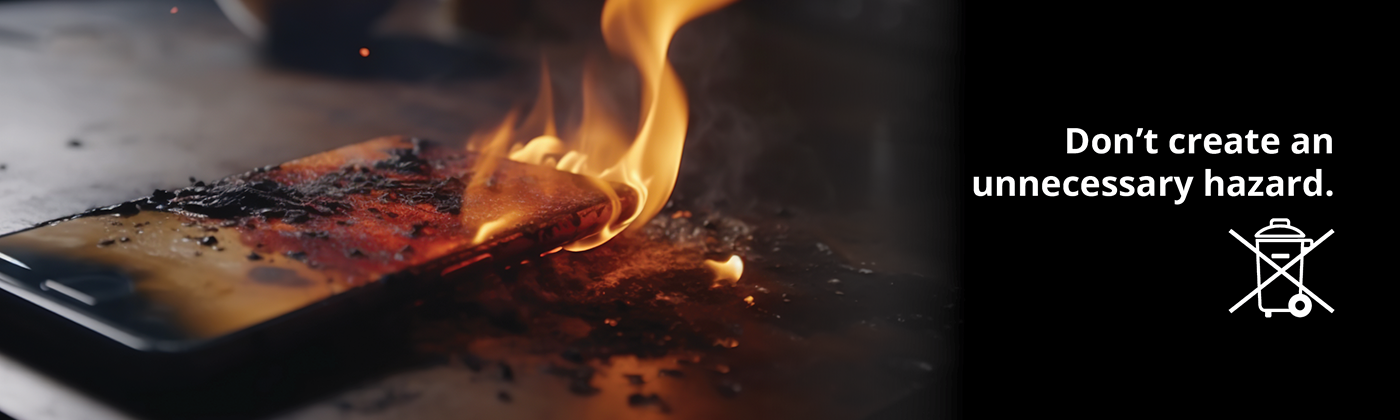
An unstable battery can
go from 212°F to 1,800°F
in the blink of an eye.
Clemson News
In 2024, UL Solutions, a testing
and certification company, received 3,880
reported incidents involving lithium batteries.
UL Solutions
Between 2017 and 2024,
495 fatalities were reported
from lithium batteries.
UL Solutions
Removing the Battery
When possible, lithium batteries should be removed from the devices they served. If the lithium battery cannot be easily accessed or removed, the entire device can be turned in with the battery still installed, as long as it fits inside a standard 5-gallon bucket.
Drop-Off Process
Lithium batteries can be brought to the Ivy Solid Waste & Recycling Center, located at 4576 Dick Woods Road, Charlottesville, VA. The facility is open Monday through Saturday from 7:30 AM to 4:00 PM. The lithium battery drop-off building is situated in the Convenience Center (location C on the map), alongside our community-facing recycling bins. Lithium batteries can be left in the 5-gallon bucket outside the building.

Program Rules & Limits
The program is free and open to residents of Charlottesville, Scottsville, and Albemarle County.
Federal law does not allow RSWA to receive lithium batteries from commercial businesses. Qualifying businesses may participate in the Commercial Hazardous Waste Program, which is offered twice per year.
Frequently Asked Questions
Q: Does the program only accept lithium-based batteries?
A: Yes, at this time, all batteries must be lithium-based. Other batteries can be turned in during our bi-annual household hazardous waste collection events held in the spring and fall.
Q: How do I know if the battery I have is lithium-based?
A: We recommend inspecting any markings or labels that the battery may have. Lithium-based batteries are often marked “Lithium”, “Li-ion”, or specific codes that begin with the letters “CR” or “RCR”. Batteries with IATA Class 9 labels also generally contain lithium.
Q: Must I drop off my batteries in a 5-gallon bucket?
A: Definitely, not! The 5-gallon bucket is purely for size estimation. We will have a bucket on-site where you can place your unwanted lithium battery.
Q: After I remove the battery, what should I do with the device it was housed in?
A: Assuming the device is not classified as hazardous waste, it can be disposed of in your household trash. If you wish to dispose of these devices while visiting the Ivy Solid Waste & Convenience Center, we offer a few options depending on the size. For devices that fit into a standard 32-gallon or smaller trash bag, you can purchase Tag-A-Bag stickers from the scale house for $2 each. Larger items can be disposed of at the transfer station. Vehicles visiting the transfer station will first need to weigh in at the scale house. Friendly staff will guide you to the appropriate area. The cost depends on the total weight, with a minimum fee of $6 plus a service fee of $1 for Albemarle County residents and $10 for non-County residents (see current rates).
Q: What Happens to the Batteries?
A: Staff will tape the contact leads and store them in a fire-resistant building. Arcwood Environmental (formerly, MXI, Environmental Services) has been contracted to provide regular pickups. They subcontract with Battery Recycling Made Easy (BRME) of Calhoun, GA, TOXCO INC of Baltimore, MD, and Metal Conversion Technologies of Cartersville, GA to provide battery recycling services.
Q: If my tablet does not have a removable battery and I turn the entire item in, will measures be taken to erase the data.
A: Unfortunately, no. RSWA is not responsible for protecting or erasing data on surrendered devices.
Common Items that Contain Lithium Batteries
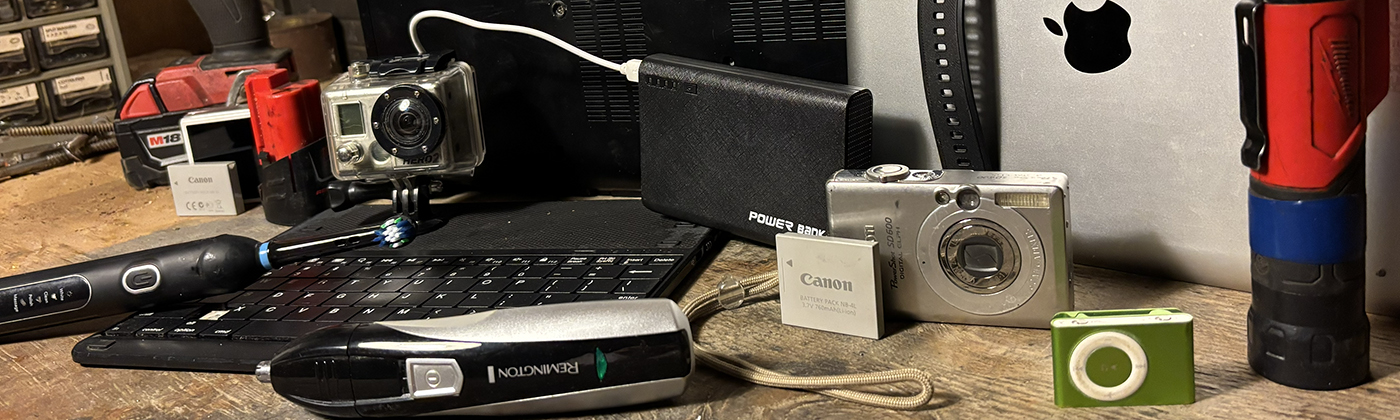
Smartphones, laptops, tablets, smartwatches, Bluetooth speakers, headphones, wireless mice, wireless keyboards, e-readers, cordless power tools, robot vacuum cleaners, rechargeable flashlights, electric razors, electric toothbrushes, hair trimmers, e-bikes, e-scooters, trail cams, video doorbells, baby monitors, remote control cars, drones, game controllers, handheld gaming devices, bike lights, handheld fans, hearing aids, and action cameras can all contain lithium batteries. When possible, we ask that you remove the battery from the device.
Kid's Corner
Meet Binny the Bin, Rivanna’s friendly trash mascot. Binny knows that lithium batteries can be dangerous if improperly disposed of. As you color, solve, and search, you’ll go on an adventure with Binny to discover which everyday items hide these powerful batteries, why they can cause fires if tossed in the trash, and where you should take them instead. Follow along and become a battery-smart hero who helps keep your home, school, and community safe!
Coloring Page

Learn what can happen to lithium batteries when they are improperly thrown away. Click the image to download.
Maze

Help Binny find the lithium battery collection center! Click the image to download.
Word Search

Can you find all the lithium battery-powered devices? Click the image to download.
Keep Refuse Workers Safe
When lithium batteries are thrown into the trash, they are susceptible to being damaged, which can lead to extremely hot, difficult-to-extinguish fires. These incidents endanger refuse and recycling workers who handle these materials every day. Proper lithium battery disposal helps protect both the public and the workers responsible for managing our waste and recycling streams.